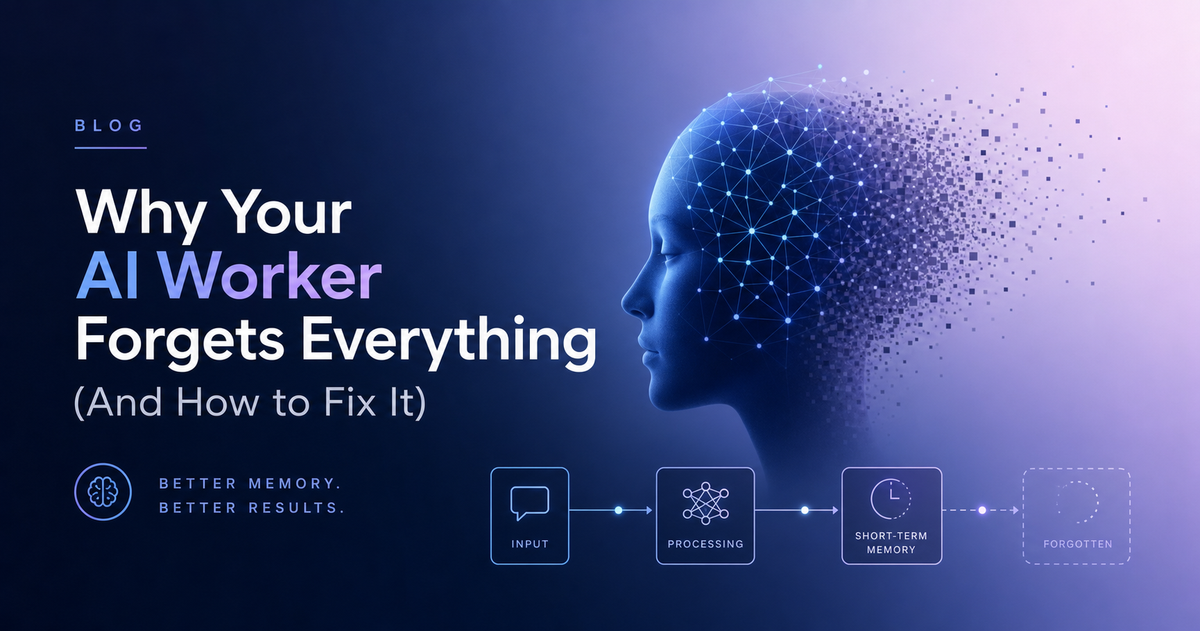
Why Your AI Worker Forgets Everything (And How to Fix It)
Most AI tools start from zero every single time you open them. No memory of what you discussed yesterday, no recall of your preferences, no awareness of past decisions. Here's why that's broken — and what a real solution looks like.
I've managed hundreds of people across four startups. One of the most frustrating things about hiring someone new? Repeating context. Explaining the same backstory, the same priorities, the same quirks of how we work — every single time.
Then I got my first AI worker. And somehow, the problem was worse.
The Amnesia Problem Nobody Talks About
Most AI tools today have the memory of a goldfish on a bad day. You spend 20 minutes explaining your project, your preferences, your constraints. You close the tab. You come back tomorrow. And it greets you like a stranger.
This isn't a minor inconvenience. It's a fundamental failure that makes AI feel like a toy instead of a teammate.
Here's what breaks down when your AI has no memory:
- You repeat yourself constantly. Every session starts with "remember when I told you…" — except it doesn't remember.
- Quality degrades over time. Without memory, your AI can't learn what works and what doesn't. It makes the same bad suggestions on day 90 that it made on day 1.
- Context gets lost at the worst moments. A follow-up from last week's conversation? Gone. That decision you explained your reasoning on? Evaporated.
- You lose trust. When a tool forgets what matters to you, you stop relying on it for anything important.
According to McKinsey's 2024 State of AI report, 72% of organizations now use AI in at least one business function. But most implementations still suffer from this same flaw: they forget everything between sessions.
Why Context Windows Aren't Memory
There's a common misconception that bigger context windows solve the memory problem. They don't.
A 128K token context window gives you maybe 100-150 turns of conversation before early context gets buried. And buried context might as well be deleted — the model effectively ignores it. More tokens doesn't mean better memory. It means more noise.
Real memory isn't about stuffing more text into a single conversation. It's about knowing what matters across conversations, retrieving it at the right moment, and connecting dots between things you said last Tuesday and what you need today.
What Real AI Memory Looks Like
True memory for AI workers needs three things:
- Persistence across sessions. When you tell your AI worker something on Monday, it should still know it on Friday. And next month. Without you repeating it.
- Intelligent retrieval. Not everything from every past conversation is relevant right now. Good memory means surfacing the right context at the right time — not dumping your entire history into every response.
- Learning from patterns. Over time, an AI worker with real memory should get better at its job. It should learn your communication style, your decision patterns, your priorities — the same way a human colleague does after working with you for months.
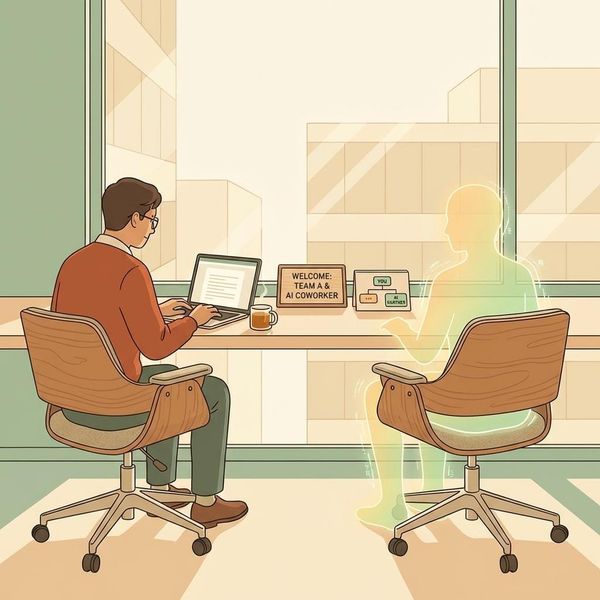
This is the difference between a chatbot and a coworker. A chatbot answers questions. A coworker remembers your last conversation, knows your preferences, and gets better every week.
What We Built (And Why It Took So Long)
At Spinnable, we just shipped Conversation Memory — and honestly, it took longer than I'd like to admit. The reason: most "memory" solutions are just fancy search over chat logs. That's not good enough.
Our approach works differently. Before responding, your AI worker automatically retrieves relevant context from past conversations. Not all context — relevant context. It pulls in prior exchanges based on what you're discussing right now, so it has the background it needs without drowning in irrelevant history.
The result: responses that feel like talking to someone who actually remembers what you've discussed. Not perfectly (we're honest about that), but meaningfully. The kind of memory that makes you stop re-explaining yourself and start trusting the tool with real work.
The Practical Difference
Here's what changes when your AI worker actually remembers:
- Week 1: You explain your communication preferences, introduce your team, describe your workflows.
- Week 2: You ask it to draft an email. It already knows your tone, who your key contacts are, and what projects are active.
- Week 4: It flags something you mentioned three weeks ago that's now relevant to today's conversation. You didn't ask it to connect those dots — it just did.
This is what turns an AI tool into an AI worker. Not more features. Not more integrations. Memory. The same thing that makes any human colleague actually useful after their first month.
What's Next
Memory is just the beginning. Once an AI worker can remember, it can learn. Once it can learn, it can anticipate. We're building toward AI workers that don't just respond to what you ask — they proactively surface things you need before you realize you need them.
But that starts with solving the amnesia problem. And for the first time, we think we have.
Want to try an AI worker that actually remembers? Get started with Spinnable — it takes about 10 minutes to hire your first worker.